
Future Prospects for the Port of Churchill on Canada’s Hudson Bay
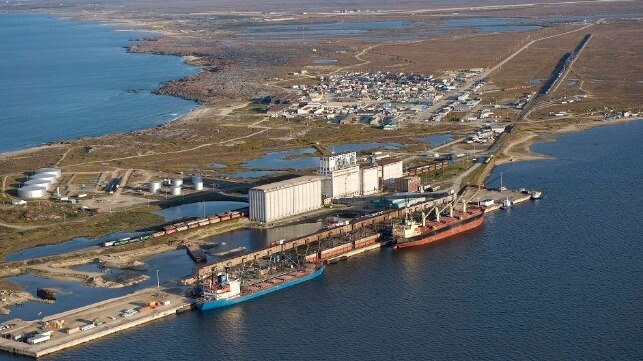
Discussions are underway in Canada in regard to the future development of the Port of Churchill on Hudson Bay. During the early to mid-1900s and prior to the opening of the St. Lawrence Seaway, Churchill was Canada’s main port for exporting Western Canadian agricultural produce to England and Europe, and could play a major role again if revived.
Introduction
The Port of Churchill is located in the northeastern region of the Canadian province of Manitoba, where the premier (equivalent to a state governor) is seeking assistance from Canada’s Federal Government to develop the port for future exports of oil and agricultural bulk freight. Several years ago, there was opposition from environmentalists in Quebec to plans to develop a pipeline intended to carry oil and natural gas from Western Canada to eastern Canada’s Atlantic provinces. There was a need across Eastern Canada for competitively priced oil and natural gas from Western Canada.
As a result of opposition to build a pipeline across Quebec to Eastern Canada, Western Canada’s oil producing region chose to seek alternative methods to export oil and natural gas to European markets. There is potential in Saskatchewan to connect an oil pipeline from Western Canada to the railway line that connects to the Port of Churchill. There is scope at that port to deepen the draft of the maritime terminal and navigation that connects to it, to accept deeper draft bulk carriers. There is also a plan to develop an offshore terminal in deeper water in Hudson Bay, close to Churchill.
Historical Factors
Dating back into the early 1800s, there was minimal east – west transportation across Canada. The colonial government in England responded by providing funding to build a navigation canal along the north side of the St. Lawrence River, upstream of Montreal. After completion during mid 1840s, small vessels began to sail between the Port of Montreal and Lake Ontario. Subsequent construction of navigation locks between Lake Erie and Lake Ontario, and between Lake Huron and Lake Superior, allowed ocean-going vessels of that period to sail between the Atlantic Ocean and the Great Lakes.
Per nautical mile, maritime transportation incurred lower transportation cost per ton (and per cubic foot of volume) when compared with railway transportation. While the inland waterway restricted the size of ocean vessels able to sail to/from Lake Superior, larger vessels of the late 19th and early 20th century could sail to the Port of Churchill. The cost of railway transportation to Port of Churchill from western Canadian wheat farms was far less than railway transportation to the Port of Montreal. As a result, the Port of Churchill proved to be practical and viable.
St. Lawrence Seaway
The construction of the St. Lawrence Seaway during the early 1950s and its opening during late 1950s allowed ocean size ships of that era passage between the Atlantic Ocean and Lake Superior. As a result, the shorter railway distance between Western Canadian wheat farms and the Port of Thunder Bay reduced transportation cost compared to the Port of Churchill. As a result, grain storage silos were built at Thunder Bay, reducing the competitiveness of the Port of Churchill. Over time, more exports moved through the Port of Thunder Bay as operations at the Port of Churchill declined.
Ship Development
Over the first five years following the opening of the St. Lawrence Seaway, the physical size of ocean-going freight ships remained essentially unchanged. By the mid-1960s, Japanese shipbuilders unveiled mega-scale bulk carriers of oil, for which there was a ready market. Over time, the physical size of carriers of dry bulk and oil increased to dimensions that exceeded the size of navigation locks along the St. Lawrence Seaway. At some locations, the sheer size of ultra-large bulk carriers required the construction of offshore terminals connected to land via undersea pipelines, to carry oil or liquefied natural gas.
There is scope to deepen the draft of the terminal at Port of Churchill, along with the navigation passage to/from Hudson Bay. Breakwaters would redirect river current to prevent deposits of silt at either the terminal or in navigation channel. There may be scope to develop an offshore terminal near the Port of Churchill, with a short distance of undersea pipeline to carry oil and/or natural gas. A precedent from Great Lakes shipping involves a small vessel sailing ahead of a large vessel to break up winter ice cover, making year-round sailing possible across Hudson Bay.
Future Prospects
There is scope to develop the Port of Churchill to serve mega-size ships that carry the combined bulk freight tonnage of a fleet of Seaway-max ships. From a common junction in Saskatchewan, the railway line to Thunder Bay is marginally shorter than the railway distance to Churchill. A structural upgrade to bridges along the line to Churchill would allow passage to trains with heavier axle loads. During winter when the ground below the railway line is frozen to several feet depth, the railway line would be able to carry a heavier load per axle.
Also, during winter, trains heavily laden per axle would be able to operate along the railway line to and from Churchill, carrying exports of bulk freight from Western Canada. Mega-size ships sailing from Port of Churchill to Europe and the Middle East would carry that freight at more competitive rates than shipping via the St. Lawrence Seaway aboard a fleet of small ships.

that matters most
Get the latest maritime news delivered to your inbox daily.
Conclusions
By opposing the construction of a pipeline through their territory, environmentalists in the Province of Quebec have provided an opportunity to explore the potential to develop the Port of Churchill on Hudson Bay. There is future scope for the port to load crude oil, potash and agricultural produce from Western Canada onto mega-size ships that will sail east across the North Atlantic, to destinations across Europe. There is also scope for container ships to sail to Churchill, to transfer containers to trains headed for Western Canada and the northwestern United States.
The opinions expressed herein are the author's and not necessarily those of The Maritime Executive.