
Navy's Unmanned Tanker Jet Has Been Approved for Production
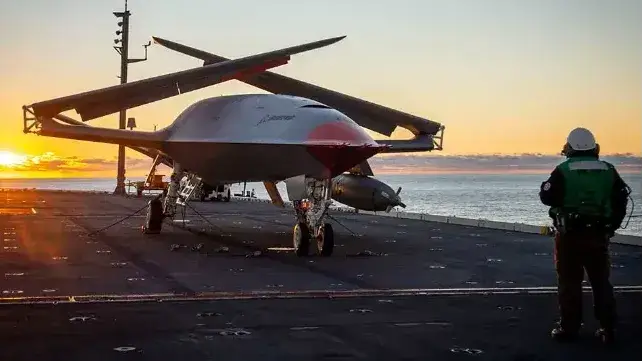
After eight years of development, the U.S. Navy has given authorization for Boeing to begin production of its long-awaited unmanned tanker aircraft, the MQ-25A Stingray. The $200 million aircraft can carry about 15,000 pounds of jet fuel aloft from the deck of an aircraft carrier, automating the routine duty of refueling strike fighters in midair - an essential task that currently falls to other strike fighters.
In operation, the Stingray will free up all of a carrier air wing's F/A-18 Super Hornets to carry out more combat missions by taking them off of tanking duty. It is also expected to augment the carrier's reach by flying along with fighter squadrons on strike missions, bearing extra fuel to extend their range.
The authorization announced Tuesday approves Stingray to pass a key development milestone and enter low-rate initial production, initially set at three airframes in the first year. The design's first carrier qualification trials are scheduled for the end of 2026.
"Moving the MQ-25A Stingray to Milestone C and into production is arming our warfighters with a capability that increases the lethality of our Carrier Strike Groups. This is a decisive advantage that delivers our warfighters what they need to fight and win," said Acting Secretary of the Navy Hung Cao in a statement.

that matters most
Get the latest maritime news delivered to your inbox daily.
The MQ-25 is unarmed, but its stealth and ultra-long range would make it a natural fit for future carrier-based strike missions. Boeing appears to have confirmed this possibility in 2024 when it displayed a scale model of the unmanned jet carrying two LRASM stealth antiship missiles under its wings. The basic hardware for the weaponization of the tanker may already be in place: the existing underwing pylons for the aerial refueling system appear to support the carriage of other external stores, potentially including the high-end LRASM (with integration).
The concept has been a long time in coming: the Navy's unmanned fighter procurement effort began in 2000, and it culminated in the X-47B carrier-capable unmanned combat aerial vehicle in 2011. However, despite success in testing, the X-47B was suspended without entering production in 2015, and the Navy began the search for an unmanned tanker design instead.