
Op-Ed: Why Women Belong at the Heart of Maritime's Future
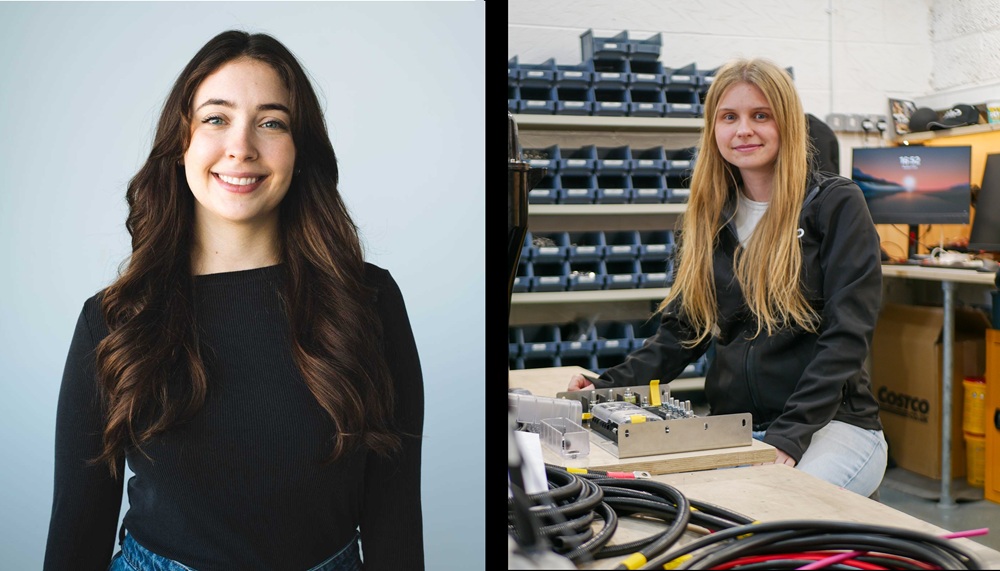
Jillian Verbeurgt and Jess Moss recently started their careers in engineering and technology, and in this essay for the International Day for Women in Maritime, they reflected on the opportunities ahead for women in the industry.
Neither of us planned a career in maritime. Our journeys began far from shipyards and propulsion systems, shaped instead by curiosity and opportunity. One of us grew up in the mountains of Canada, the other attended an all-girls school in south east London. Yet despite these very different beginnings, our paths converged in an industry undergoing profound change. Maritime is evolving - technologically, culturally, and environmentally - and women are increasingly part of that transformation.
Finding our way into maritime
Jillian:
I moved to Iceland in 2017 to study sustainable energy sciences, and during my master’s I was introduced to machine learning and data science. That led me to founding a food-tech startup, which I ran for five years. It was exhausting, but it taught me what it means to introduce new technology into traditional industries, something I’ve since realised is very similar in maritime.
When I eventually met the team at Hefring Marine, the fit was immediate. I’d never lived near the ocean growing up, but after nine years in Reykjavík, maritime had become part of my everyday life. Joining Hefring felt like stepping into a sector where innovation could genuinely improve safety and sustainability. That’s what pulled me in.
Jess:
My route was more traditional, but equally unplanned. I went to an all-girls school where subjects like design technology disappeared early on, so I didn’t reconnect with engineering until a teacher launched a computer science GCSE. That changed everything. I went on to study computer science, maths and physics at A-level, then engineering at university, one of only around 20 women in a cohort of 200.
After a placement and early career in manufacturing engineering, I moved into electrical and mechanical design. When RAD approached me, the idea of working on electric propulsion systems felt like a natural next step. Living in Portsmouth, maritime is part of the community, so ending up in this industry feels almost inevitable in hindsight.
The people who shaped us
Neither of us got here alone.
Jess:
I’ve been lucky to have women around me who pushed me forward, teachers who encouraged girls into STEM, lecturers who reassured me when I doubted myself, and colleagues who treated me as an engineer first, full stop. At university, I graduated top of my class, but I still needed those voices reminding me that I belonged.
Jillian:
For me, mentorship came later. Working on the NATO DIANA accelerator has been transformative. The team at COVE in Canada, who we collaborate with, have been incredibly supportive, both professionally and personally. And within my current role, I’ve always felt backed. Being put forward for opportunities from day one has given me confidence I didn’t know I needed.
Positive environments
Our experiences have been overwhelmingly positive, but not identical.
Jillian:
Working on the innovation and tech side of maritime, I haven’t faced the assumptions many women historically have. I’m not on vessels, and I know that experience can be very different. But in the spaces I work in, gender balance feels further along.
Jess:
I’ve had moments, mostly at university, where people questioned whether I was “supposed” to be there, or assumed I was a diversity hire. Those comments stay with you. But in industry, I’ve been careful about choosing environments where I feel supported, and that’s made all the difference. At RAD, I’m treated exactly the same as any other engineer, which is how it should be.
Cultural changes
We both think the culture of maritime is changing, though progress varies by country and by part of the industry.
Jillian:
In Canada, I’ve met many women in the Coast Guard and even high-ranking women in the Navy. Iceland, where I live, is one of the most gender-equal countries in the world, and I hope that continues to influence maritime here. There’s still work to do, especially on vessels, but change is happening.
Jess:
At university, I noticed something interesting: most of the top academic awards went to women. Not because women are inherently better engineers, but because many of us feel we have to prove we deserve to be there. I hope the next generation won’t feel that pressure, that being a woman in engineering will be unremarkable.
Jillian:
The more the industry modernizes, the more opportunities there are for women to enter maritime through adjacent fields: data, AI, sustainability, engineering. Innovation creates space.
Jess:
But we need to start earlier. Many girls never encounter engineering until late in school, if at all. Outreach, visibility, and honest conversations about what engineering and maritime actually involve could change that. If young women don’t know these careers exist, they can’t choose them.
Advice for young women considering maritime
Jillian:
Try it. There’s no harm in dipping your toes in, literally or figuratively. If going straight into maritime feels daunting, start somewhere adjacent. Careers aren’t linear, and you can always move deeper into the industry as your confidence grows.
Jess:
Seek out experience days, placements, networking events, anything that gives you a glimpse of the real work. And ignore the people who think you don’t belong. Find the spaces where you’re valued for your skills, not your gender.
that matters most
Get the latest maritime news delivered to your inbox daily.
Looking ahead
In five to ten years, we hope maritime looks more like Iceland does today: gender-equal, innovative, and open. We hope women in maritime technology become the norm, not the exception. And we hope young women see this industry not as a male-dominated space, but as a place where they can thrive.
Jillian Verbeurgt is an executive associate at Hefring Marine and Jess Moss is a mechanical design engineer at RAD Propulsion.
The opinions expressed herein are the author's and not necessarily those of The Maritime Executive.