
Philly Wins its First U.S. Navy Design Contract Under Hanwha's Management
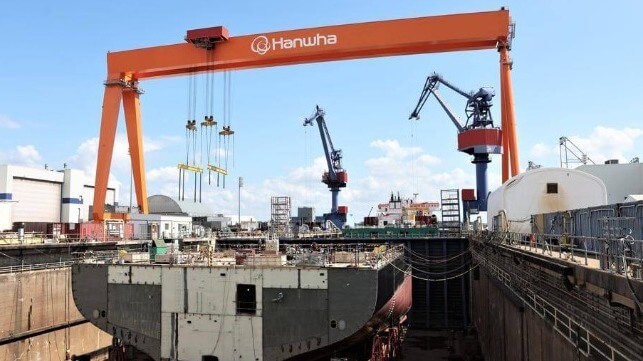
Hanwha Philly Shipyard has won its first Navy newbuild project under its new Korean management - a subcontract to Vard for the light replenishment oiler (T-AOL) project. Hanwha will be involved in the vessel's conceptualization; a market survey of existing foreign designs; cost analysis; and optimization for manufacturability - lining Hanwha up well to compete for possible orders for construction.
The T-AOL - also branded the Next Generation Logistics Ship (NGLS) - is designed to leverage commercially available technologies to provide sustainment for U.S. Navy forces operating forward, including provision of fuel, supplies and ammunition. They are conceived of as a smaller, lighter, less expensive oiler, easier to deploy into coastal waters and combat zones. Based on early studies, the notional size is likely in the range of about 3-4,000 dwt. The FY2023 shipbuilding plan projected a cost of about $150 million per hull - a small fraction of the $800 million price of a new John Lewis-class fleet oiler. Advance procurement funding of $100 million was included in the One Big Beautiful Bill Act last year.

that matters most
Get the latest maritime news delivered to your inbox daily.
"Hanwha is proud to partner with VARD in the design and integration of the Next Generation Logistics Ship for the U.S. Navy," said Hanwha Defense USA President of Shipbuilding Tom Anderson. "This award represents an important step in our ability to leverage our world-class shipbuilding expertise in building the ships the Navy needs."
The sealift fleet is at top of mind for the Navy's leadership, as carriers and destroyers can only operate for so long before they have to resupply. Military Sealift Command has had a long-term challenge with manning, and has had to idle some of its smaller support vessels because it does not have enough mariners to run everything in the fleet. Last week, CNO Adm. Daryl Caudle told an audience at the Navy's Singapore station that he is concerned that Military Sealift Command has become fragile and overextended from heavy use. "MSC is where I probably lose the most sleep worrying about that fleet and what we’re doing with it. So much rests on it and this is the center of gravity for this in the Indo-Pacific," he said, per USNI News.