
Port of Baltimore Had Second Best Year as Recovery Continues
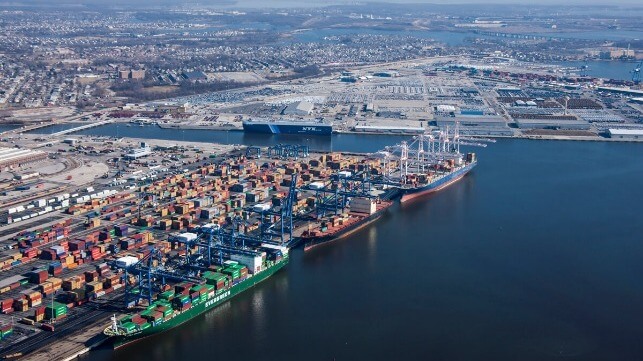
The Port of Baltimore reported its second-best year ever in 2025 as it continues to recover from the devastation of the Francis Scott Key Bridge collapse. Marking the second anniversary of the allision, which destroyed the bridge and closed most parts of the port for weeks, Maryland Governor Wes Moore announced that the combination of public and private terminals that comprised the Helen Delich Bentley Port of Baltimore handled approximately 50 million tons of cargo in 2025 and is poised to show strong growth this year.
“Once again, Maryland’s Port of Baltimore proves it is one of our nation’s top economic assets as it continues to rebound from the collapse of the Francis Scott Key Bridge in 2024,” said Gov. Moore. “With an annual economic value of $70 billion and more than 273,000 jobs in Maryland tied to the port, our state is stronger with a successful Port of Baltimore.”
The total cargo handled last year had a value of $65.6 billion—the third-highest value in the port’s history. The 2025 total exceeded Baltimore’s 45.9 million tons of cargo handled in 2024, finishing only behind 2023’s record of 52.3 million tons.
The port had a long list of achievements during 2025. Overall, Baltimore finished 10th among all U.S. ports for foreign cargo value ($65.6 billion) and 11th for foreign cargo tonnage (49,983,622 tons).
The Port of Baltimore set records for containers and total cargo ship visits. The container terminal handled 1.1 million TEU and 2,223 vessels last year—a 21 percent increase over 2024. It also saw an increase in its weekly container services from 12 in 2024 to 15 in 2025. The port handled about 11.1 million tons of autos, farm and construction machinery, containers, forest products, and breakbulk at its public terminals, which was the third-largest amount in the port’s history.
RoRo volume continues to be a significant part of the port. The port handled 887,513 tons of roll-on/roll-off farm and construction equipment in 2025—a six percent increase over 2024 and the highest among all U.S. ports. The Port of Baltimore also handled 728,225 autos and light trucks in 2025—second overall in the U.S. and the 13th consecutive year exceeding 700,000 units.
Other key areas included 1.1 million tons of forest products (rolled paper and wood pulp), which placed Baltimore first among all ports in America. It was second in the U.S. for exported coal and imported aluminum, gypsum, salt, and sugar.
In addition to its cargo business, the Port of Baltimore has evolved into a popular cruise homeport. In 2025, 413,639 passengers took a cruise from Baltimore, ranking in the top 10 of passenger counts in the port’s cruise history.

that matters most
Get the latest maritime news delivered to your inbox daily.
Officials note that the Port of Baltimore’s container business will be enhanced in 2026 with the completion of the $518 million CSX Howard Street Tunnel Project. The project includes modernizing the 130-year-old Baltimore freight tunnel and making clearance adjustments at 22 points between Baltimore and Philadelphia, allowing for double-stacked container trains to travel to and from the port. The project is expected to increase the port’s business by approximately 160,000 containers annually and generate nearly 14,000 jobs.
The results come as efforts are getting underway to build a replacement bridge. Initial contracts have been awarded, but late last year, Maryland officials announced that the projected cost had more than doubled, to an estimated $4.3 billion to $5.2 billion. They anticipate the new bridge will be completed by late 2030.