
Port of Long Beach Offers $1M Prize for First Methanol Bunkering
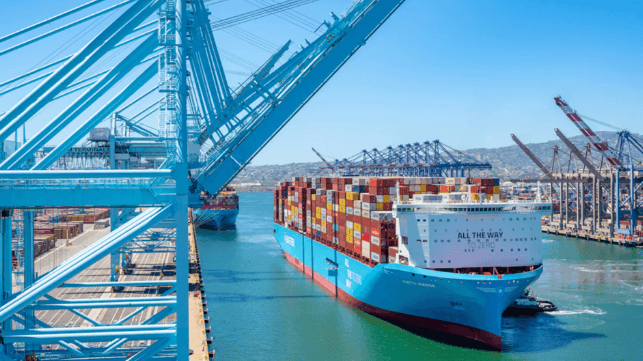
The Port of Long Beach wants to have methanol bunkering available to support the next generation of dual-fuel ships, and it has selected a novel way of going about it. The port's commission has signed off on an incentive award - a prize - that will be awarded to the first ship to carry out a full-scale methanol bunkering evolution at Long Beach.
The port's "Clean Fuel Bunkering Challenge Incentive Award" is a $1 million prize, payable to a vessel operator rather than a fuel supplier. Details on eligibility will be forthcoming, the port said.
There are about 400 dual-fuel methanol ships in operation today, but most still run on bunker fuel, since practical supplies of green methanol are scarce. Gray methanol - derived from natural gas - has a higher carbon footprint than HFO due to the energy-intensive process of manufacturing it, and is not viewed as a long-term climate-friendly solution; carbon capture during the production process can reduce this concern, resulting in low-emissions blue methanol.
"We know the shipping industry is considering moving toward adopting methanol marine fuel for some great reasons – they want to reduce greenhouse gas emissions and improve air quality. Today, we’re giving them 1 million more reasons to embrace clean fuels," said Port of Long Beach CEO Dr. Noel Hacegaba. "We’re also seeing how rising fuel costs are strengthening the case for energy diversification and greater energy independence."
Beyond climate benefits, methanol is advantageous for its clean-burning emissions profile. It releases 95 percent less particulate matter, 99 percent less sulfur oxides and 60 percent fewer nitrogen oxides - a major improvement for those who live in smog-affected areas near the port. (This has been studied at Long Beach before: a Maersk-led project examined methanol as a fuel for cargo-handling equipment back at least as far as 1992.)

that matters most
Get the latest maritime news delivered to your inbox daily.
"Frontline communities in Los Angeles and Long Beach suffer from some of the worst pollution in the nation," said Cristhian Tapia-Delgado, Climate Campaigner for Southern California, Pacific Environment. "We applaud the Port of Long Beach for approving $1 million to move ocean shipping lines to clean bunkering, but we urge the Port to do everything possible to ensure the cleanest, safest and most sustainable alternative fuels are the ones that achieve long-term success at the Port."
In 2024, the dual fuel methanol boxship Alette Maersk called at neighboring Port of Los Angeles; she made the Pacific crossing on a combination of green methanol and biofuels, but it is understood that she did not take on green fuels during her visit to San Pedro Bay.