
Zim's Union Makes Push to Block Hapag-Lloyd's Buyout Offer
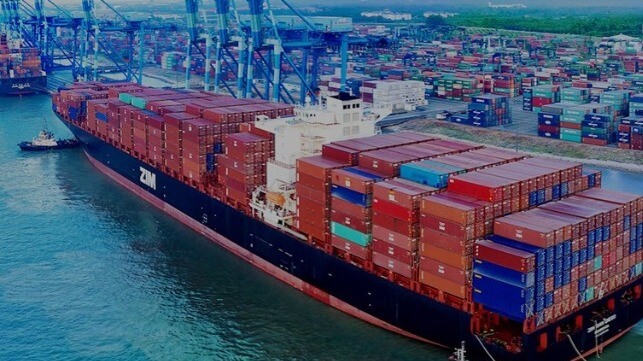
As the architects of the Hapag-Lloyd-Zim merger make their case to the Israeli government, Zim's union is making every effort to bring the deal to a halt, even blocking the company's chairman from entering the firm's facilities.
According to Israeli outlet Calcalist, Zim union employees picketed outside of the firm's sites in Ashdod, Holon and Haifa, and the union's leadership stated that chairman Yair Seroussi would be prevented from entering. Seroussi spearheaded negotiations on the sale of the firm to Hapag-Lloyd, along with Hapag representative Samer Haj-Yehia.
Union leader Oren Caspi says that the sale of Zim would leave Israel more dependent on foreign-owned logistics for trade from East Asia if the sale were permitted to go through. The deal is structured to hand most of the company and its network of international routes to Hapag, while the Israeli core of Zim is spun off as a "new Zim" with 16 ships and zero debt. The newly-formed, much-reduced Zim would be wholly owned by an Israeli investment fund, FIMI.
Caspi alleges that out of 1,000 workers on the payroll today, Hapag is offering a one-year contract to just 120 people, and the rest face a precarious future. In contrast, Haj-Yahia told Israeli outlet Globes that Hapag wants Zim's talent and intends to retain about 80 percent of the Zim workforce; he intimated that the German firm has no intention of conducting mass layoffs of the type seen in other foreign M&A deals.
Zim predates the existence of the Israeli state, and it is both a symbol of identity and a sovereign lifeline for foreign trade. During certain events of the conflict in Gaza, foreign protesters attempted to block merchant shipping to Israel, and to convince foreign shipping lines that Israeli trades were not worth running; Zim resolves such problems.
"Zim is not an ordinary commercial company. During wartime, Zim’s vessels served as a vital channel for supplying ammunition, food, and medicine to the State of Israel," the union told Calcalist in a statement. "Selling it to a foreign shipping company would seriously harm the state’s ability to act independently in times of emergency. We are not just fighting for our jobs, we are fighting for the security of every Israeli citizen.”
Zim provides sealift services for the Israeli military in time of war, and the Israeli state holds a "golden share" that gives it certain rights to control the company's direction, including requirements for the firm to maintain a minimum-size Israeli-controlled fleet.
In comments before the Knesset Economic Affairs Committee, FIMI CEO Ishay Davidi argued that the new Zim would be compliant with Israeli sealift requirements, and would be fiscally stronger than before. He told the committee that there were times in the past when Zim did not actually meet "golden share" requirements, and that the restructured entity would be able to meet wartime sealift needs, "with an exclamation point."
"FIMI will be the 100% owner of Zim. We are establishing a company with $700 million in equity, and no debt at all. ZIM, as of today, has liabilities on the ships amounting to $5–6 billion, and we have no such [liabilities]. The 16 ships, of which 12 are fully-owned by us, are going to be newer than what Zim has," Davidi said.
Union leader Caspi was less optimistic. "They threw us to the dogs," he said. "There is dirty Qatari money here, and we hope that the state will come to its senses and not let this happen." A Qatari sovereign wealth fund owns 12 percent of the shares in Hapag-Lloyd, a consequence of Hapag's earlier acquisition of UASC.

that matters most
Get the latest maritime news delivered to your inbox daily.
Hapag advisor Samer Haj-Yehia told Israeli outlet Globes that the revised "new Zim" - while smaller - would be more Israeli and more fiscally robust than the old one. "ZIM is currently traded in the US with 90% non-Israeli owners," he said, noting the possibility of a hostile takeover. "By contrast, now there will be a company . . . incorporated in Israel in which all the directors are Israeli, with an Israeli CEO, Israeli managers in every department, and managed by the most successful Israeli fund."
He predicted that the new debt-free Zim would be very well-positioned, and would likely have a successful IPO in the near future. "This company will be amazing. I would invest in it," he told Globes.