The Hybrid Adjustable Tip Propeller: Adaptability and Efficiency
Across all vessel types, operators are being asked to cut emissions, protect schedules and keep assets productive in a world of shifting routes, speeds and fuel strategies. Fundilusa/EGM’s Hybrid Adjustable Tip (HyTIP) propeller, underpinned by its proven Modular Blade System (MBS), is designed for that reality: propulsive efficiency that can adapt as operating conditions change.
The propulsion challenge has changed
For decades, many propulsion designs were assessed around a single nominal operating point. Today, the operating reality is rarely fixed. Slow steaming, schedule recovery, charter changes, varying drafts and weather routing can move a vessel away from its design condition for long periods.
When that happens, the penalties compound: fuel burn rises, cavitation margins tighten and noise and vibration risk can increase. That is why Fundilusa/EGM has focused innovation where it has outsized leverage - the blade’s terminal region - and developed the Hybrid Adjustable Tip (HyTIP) propeller to help owners protect performance across a wider operating envelope.
“Shipowners don’t operate at one design point - they operate across seasons, cargoes, routes and realities. HyTIP propeller is about giving operators a practical way to protect propulsive performance when conditions change, without forcing them into irreversible design choices," says Pablo Gonzalez, Group Owner and CEO, Fundilusa/EGM.
Why the tip matters
The industry has long recognized that millimeter-scale changes in propeller geometry can make a meaningful difference. These small-scale variations are well known to anyone who has encountered “singing propeller” noise, where a manufacturing deviation of less than a millimeter can trigger an audible tonal effect that readily transmits through the ship’s structure and is heard throughout the vessel.
At the outer radii — where a large share of the propeller’s thrust and power are generated — pressure gradients intensify, vortical structures form, and the onset of cavitation can become highly sensitive to local shape, rake and skew.
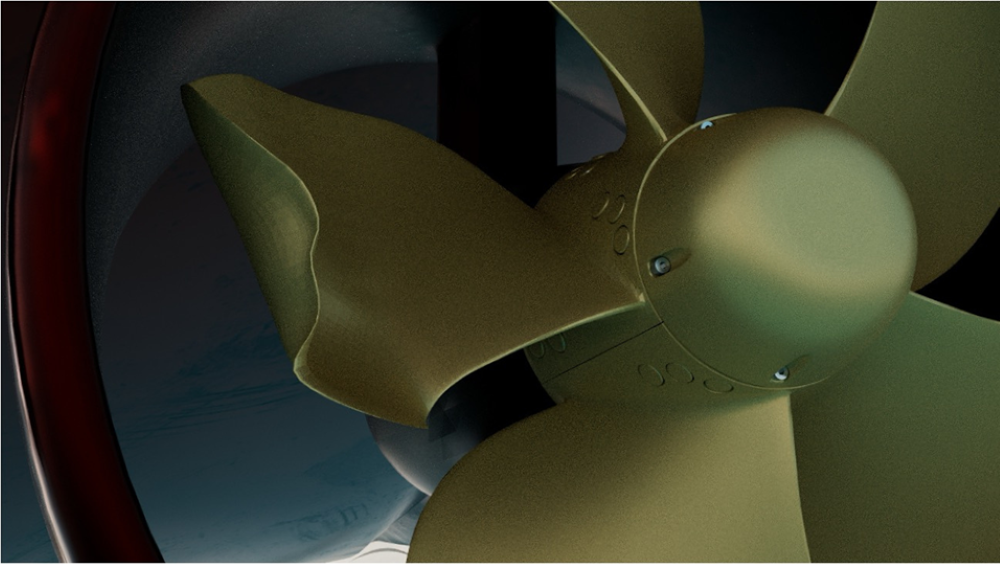
The tip region is a high-performance and high-risk part of a propeller blade. While a well-designed tip can improve efficiency, a poorly designed tip could increase the risk of cavitation and ultimately vibrations – hence our technology, HyTIP, focuses on the outer part of the blade.
From fixed tip geometries to a configurable subsystem
Many solutions in the market rely on fixed, permanent geometry. They can deliver value, but they are inherently irreversible: if the operating profile changes, or if the selected geometry proves suboptimal, the path to correction can be disruptive and costly.
The HyTIP propeller takes a different approach. The blade is organized into a main body, a structural transition zone and a hybrid adjustable tip, allowing the terminal region to be engineered as a functional subsystem rather than a one-time geometric decision.
In practical terms, this enables targeted adjustment of tip-region behavior without redesigning the remainder of the blade - reducing development risk and supporting lifecycle flexibility.
What the HyTIP propeller is designed to do (in plain terms)
The HyTIP propeller is designed to improve propulsive efficiency through controlled redistribution of hydrodynamic loading near the tip, optimizing pressure distribution and reducing the occurrence of cavitation, noise and local pressure peaks. It is intended for fixed pitch propellers (FPP), controllable pitch propellers (CPP) and built-up propellers, and is applicable both in open flow and within ducts or nozzles.
Depending on the vessel’s duty cycle and constraints, the adjustable tip may incorporate non-uniform functional camber, three-dimensional variation of local pitch and/or angle of attack, and a flow-control element to fine-tune local flow.
A practical innovation is the detachable blade tip — an interchangeable element within the HYTIP design — which may be realized either as a modified rigid tip geometry or a flexible tip material. This enables targeted adjustment of the flow in the tip region without any need to modify the remainder of the blade geometry.
“The breakthrough is not simply a new shape — it’s a new way to adjust performance and manage risk. When the tip becomes a functional subsystem, you can tune cavitation behavior, reduce pressure pulses and noise, and enhance hydrodynamic performance to better match the vessel’s operating profile. The result is lower fuel consumption, reduced emissions, and improved lifecycle performance," says Dr. Saeed Javdani, Global Technical Director, EGM.
At a glance:
• HyTIP: configurable blade-tip subsystem focused on tip region optimisation
• Flexible tip option: passive tip offloading under hydrodynamic load (approx. 1-2 degrees elastic twist)
• MBS: modular, built-up propeller foundation with CNC-machined blades and balance records
• Installed across vessel types; operating under major classification societies (e.g., ABS, LR, BV, DNV, RINA, ClassNK)
Passive adaptation with flexible tips
A distinctive HyTIP propeller option is the use of a composite (CFRP) adjustable tip, engineered with torsional stiffness selected to deliver controlled elastic twist under hydrodynamic loading. Within the composite tip section, a stable elastic torsion of approximately 1–2 degrees can occur, helping to limit pressure peaks, delay cavitation onset, and reduce noise and vibration.
In simple terms, the tip can offload passively as loads rise - without adding to the crew workload or the need for an active control system - helping the propeller maintain its optimal performance as speed, draft and sea state change.
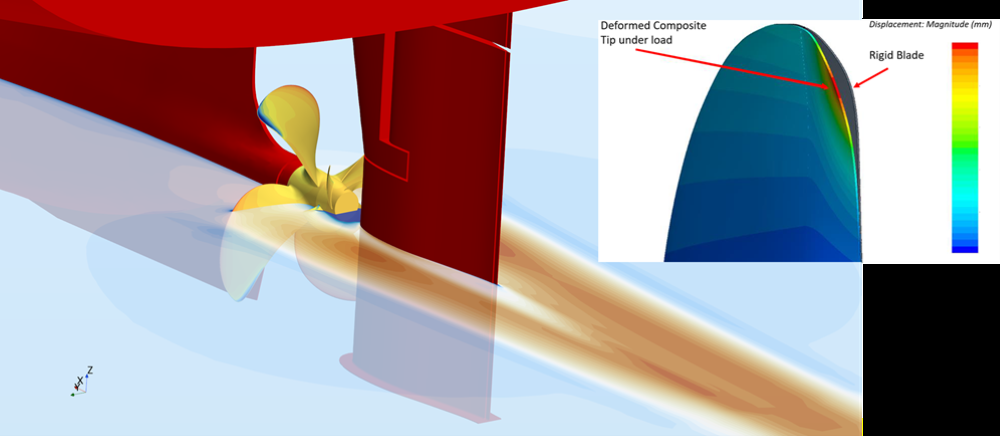
Flexible composite tips can deliver passive tip offloading under hydrodynamic load, supporting cavitation control and noise/vibration reduction. (FSI Simulations on a 5.6-meter diameter propeller of a tanker)
Matching propeller design to operating environment
HyTIP can be configured to suit the vessel’s operating conditions and the dominant damage mechanisms at the tip:
- Abrasive or silt-laden service (often shallow-water and inland routes): a wear-oriented, replaceable tip or leading-edge protection concept can be used to manage erosion and allow straightforward renewal once abrasion has accumulated.
- High-impact service (ice, debris, or frequent contact risk): impact-resistant metallic tips are appropriate where robustness is paramount, including work-hardening austenitic manganese (Hadfield-type) steels in applications where repeated shock loading and impact wear are expected.
- Variable duty cycles where passive adjustment adds value: flexible composite tips can be engineered to deliver passive bend–twist (self-twisting) behavior under hydrodynamic loading, helping stabilize terminal-region loading and cavitation behavior without adding operational complexity.
- Programs that benefit from iteration during development or through-life support: removable metallic tip embodiments enable local replacement or refinement at the terminal region without reworking the main blade body, reducing the cost and disruption of geometry changes.
Where dissimilar materials are combined, the interfaces should include galvanic-corrosion controls — typically by electrically isolating the materials (dielectric barriers or insulating sleeves/bushes where practicable) and by detailing coatings/seals to minimize seawater ingress at the contact surfaces.
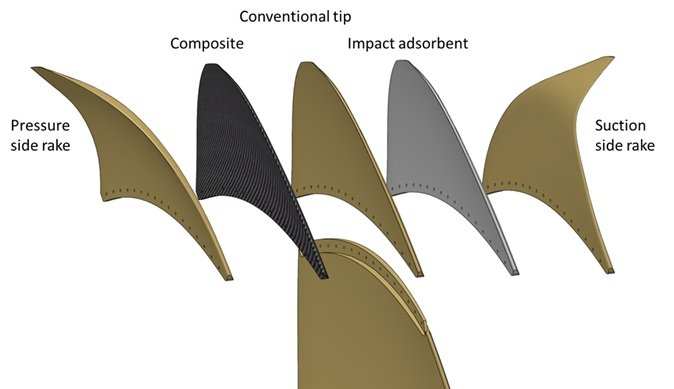
The HyTIP propeller tip region can be matched to operating priorities: abrasion, impact, passive offloading and efficiency.
MBS: the proven modular foundation beneath the HyTIP propeller
The HyTIP propeller is designed to leverage the lifecycle advantages of Fundilusa/EGM’s Modular Blade System (MBS) — a detachable-blade propeller architecture already installed across multiple vessel types, including cargo, Ro-Ro and chemical tankers.
For operators, modularity delivers practical value: individual blade replacement in the event of damage; repair and maintenance options that, where conditions allow, can be carried out with the vessel afloat; and simpler component logistics compared with transporting and handling a large monoblock propeller.
MBS blades are fully CNC machined, with blade mass properties measured and recorded to support consistent balance and tight geometric tolerances. The result is a robust foundation for smooth operation, repeatable performance and longer component life.
MBS propellers are in operation under a range of classification societies, including ABS, Lloyd’s Register, Bureau Veritas, DNV, RINA and ClassNK.
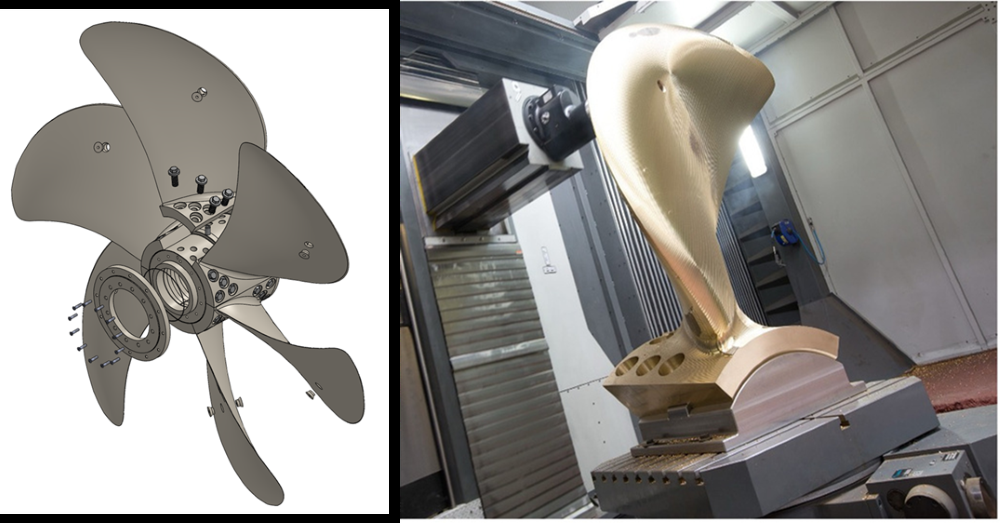
MBS modular architecture supports uptime: repair, replacement and upgrades without a full monoblock change-out.
“Operators want efficiency improvements, but they won’t sacrifice uptime to get them. MBS was built around practical maintenance and fast recovery - and that modular foundation – MBS – helps make advanced concepts like HyTIP more adoptable at fleet level,” says Wayne Wingate, Co-Owner, EGM America.
Small changes, measurable results: noise, comfort and environmental impact
Underwater radiated noise is drawing increasing attention across multiple segments — from high-end passenger and yacht markets to naval programs and operations in environmentally sensitive areas. The propeller’s terminal region is one of the most effective levers for influencing acoustic behavior, because tip geometry strongly affects cavitation inception and the intensity of tip-vortex structures that can drive pressure fluctuations and radiated noise.
Fundilusa/EGM points to a practical example: in one superyacht application, introducing a pressure-side tip rake reduced noise levels across the shaft-speed range by 4 dB. While every vessel has its own hydrodynamic signature, the message is consistent — tip-level engineering can deliver measurable acoustic benefit when it is optimized for the vessel’s operating profile.
What owners and operators can expect
The HyTIP propeller is designed to translate blade tip optimization into outcomes that matter commercially and technically:
- Fuel and emissions: tip adjustment aligned to a vessel’s operating profile can deliver up to 10% fuel saving in suitable cases (results depend on baseline condition and duty cycle).
- Reliability and lifecycle: by treating the tip as a subsystem, adjustments can be localised and matched to environment - abrasion, impact, or passive offloading needs.
- Consistency and smoothness: with MBS, fully CNC-machined blades and recorded mass properties support tighter balance and repeatability compared with typical monoblock realities.
- Noise and vibration: terminal-region refinement can reduce pressure peaks and delay cavitation, supporting comfort, equipment life and underwater radiated noise objectives.
A practical route to adoption
For many owners, the question is not whether to pursue efficiency - it is how to do it without operational disruption. Fundilusa/EGM’s approach supports a stepwise pathway:
- Baseline assessment: understand the vessel’s true operating profile and current propulsive performance.
- Engineering and optimization: tailor terminal-region behavior and blade set to the duty cycle and constraints.
- Manufacture and quality: deliver repeatable, CNC-machined geometry and documented balance.
- Installation plan: align with yard windows and operational constraints; leverage modular assembly where applicable.
- Verification in service: demonstrate performance with real operating data, then refine where appropriate.
Next step: pilot demonstration
The HyTIP propeller has completed the development stage and is moving into pilot demonstration. The target vessel is a small chemical tanker, with the pilot planned over the next six months.
The objective is to validate the benefits that matter in service: efficiency resilience across varying speeds and loads; cavitation and noise behavior at the tip; and the practicality of the blade-tip subsystem approach, supported by MBS lifecycle advantages.
Conclusion
As shipping navigates decarbonization and increasingly variable operating profiles, the propeller remains one of the highest-leverage devices on board. Fundilusa/EGM’s HyTIP propeller reframes the blade tip as a configurable subsystem: optimizable, maintainable, and capable of passive adaptation where appropriate - underpinned by the proven modular and manufacturing advantages of MBS.
For ship owners seeking measurable efficiency without sacrificing uptime, the next step is collaboration: define the operating profile, set performance targets, and select a pilot pathway that proves value in the real world.
For more information on Fundilusa/EGM, visit https://www.fundilusa.com.
The opinions expressed herein are the author's and not necessarily those of The Maritime Executive.