
After US Airstrikes, Iran Declares Hormuz "Closed" to All Vessel Traffic
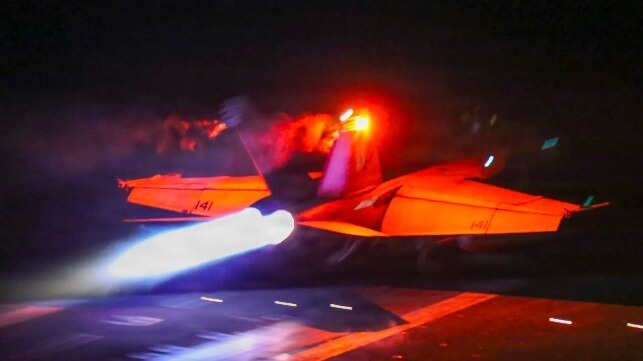
Oil futures ticked up Thursday morning as Iran and the United States traded strikes and counterstrikes, with renewed threats of violence prompting energy traders to consider timing predictions for the reopening of the Strait of Hormuz.
The escalation cycle began Monday when an Iranian drone downed a U.S. Army helicopter in the Strait of Hormuz, forcing the U.S. Navy to launch an inventive and successful rescue operation. Both helicopter pilots survived and were delivered to shore in stable condition.
Following the rescue, the White House ordered "proportionate" counterstrikes targeting Iranian military sites along the perimeter of the strait, including radar installations and air defense sites. (Iran also claims that U.S. fighters hit water storage tanks near the city of Sirik.)
On Wednesday, at the request of President Donald Trump, U.S. forces launched another wave of airstrikes across Iran, hoping to convince the regime in Tehran to agree to U.S. proposals for a long-term ceasefire agreement. U.S. officials assert that no civilian infrastructure was hit. Iran said that it retaliated with ballistic missile counterstrikes targeting U.S. installations in Bahrain, Kuwait and Jordan, including attempted attacks on U.S. 5th Fleet headquarters and Muwaffaq Salti Air Base; the effects (if any) have not been reported, but bystanders on social media recorded extended air defense engagements over these locations.
A large barrage of Iranian ballistic missiles has been launched at Muwaffaq al-Salti Air Base in Jordan.
— Egypt's Intel Observer (@EGYOSINT) June 11, 2026
Air defense interceptors can be seen engaging incoming missiles over the base, while separate footage shows fires raging following a reported direct hit. pic.twitter.com/hzgqHJxEbm

that matters most
Get the latest maritime news delivered to your inbox daily.
In response to the renewed exchange of fire, Iran has changed its official view of the Strait of Hormuz's status. Previously, in Iran's view, the waterway was "completely open" under Iranian management via the "Tehran Tollbooth" permission system. Effective Thursday, it is now "closed effective immediately for the passage of all types of vessels, including oil tankers and commercial ships," and any vessel attempting to make the transit will be attacked, reported government-affiliated outlet Tasnim. While the probability of this threat turning into a kinetic strike is uncertain, it suggests an Iranian attempt to clamp down on a steady leak of U.S.-guided merchant vessel traffic, which has been gradually increasing for the past week.
"This week has brought wider attacks and further deterioration where the ceasefire is more like a lesser-fire," commented UN Secretary-General António Guterres. "We should not minimize the risks of lesser fire becoming full fire. All parties must work towards a diplomatic settlement. No more attacks. No more excuses."