
Atlantic Crossing Attempt in Four-Foot Boat Ends in Rescue off Newfoundland
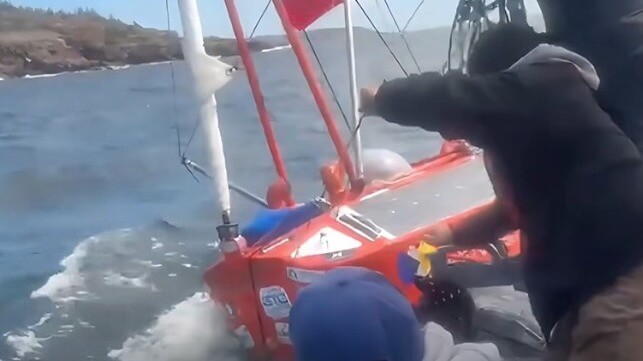
The prospect of chasing a world record holds a certain fascination for adventurers, and often leads them in unusual directions. The record for a shortest-boat ocean crossing is one case, as it has a striking effect on the design of the craft. The pursuit of an ever-shorter hull forces difficult naval architecture choices as it reaches its logical limit - the dimensions of the human occupant - and there are obvious implications for safety. The last two serious attempts at a shortest-vessel Atlantic crossing both ended early, both under the same skipper; the latest happened just last week and appears to be the last, for now.
Longtime sailor Andrew Bedwell, 52, has been working to break the record for shortest boat to cross the Atlantic since 2022. His first attempt in the homemade fiberglass vessel Big C ended near the pier because the boat was dropped during deployment, causing significant damage.
The revised Big C V2 in testing (Andrew Bedwell / Big C Atlantic Challenge)
His latest attempt began on June 4, when he set out from Newfoundland aboard the Big C V2, a much-revised aluminum sailing vessel measuring 3.9 feet from bow to stern (smaller than a dining room table). For reasons of a "fluke accident" that could have endangered his life, Bedwell called for Canadian Coast Guard assistance on June 6, just three days after he started out. The cutter CCGS Sacred Bay diverted to the scene and rescued him at about 1415 hours, returning him safely to shore. The boat could not be recovered in the rescue, and was abandoned adrift at sea. Bedwell told the Lancashire Post that he would not be attempting the crossing again, and would "move on."
"I have spent the last four years of my life working towards this challenge. I'm conscious of how much time I have given to it, how much money my family has invested in it, how much time and money my sponsors have invested in it," he wrote in a social media post. "I would truly love to break this record, but there comes a time when you have to ask yourself at what cost. Not just to myself but to everybody else who's involved."

that matters most
Get the latest maritime news delivered to your inbox daily.
The logic of the length competition means that steadily-shrinking design requirements have pushed contenders out of conventional small craft (like the 1965 record-holder Tinkerbelle, a modified but commercially-built 13.5-foot dinghy) and into custom, purpose-built pods. At this level of extremity, the minimum-length criterion imposes challenges on the rest of the vessel. To maintain enough internal volume for the occupant and their supplies, there is little room for a taper to the bow or stern, leaving a rectilinear tub with a maximum speed in the low single digits. Aboard Big C V2, the 3.9-foot LOA provided too little room to carry a life raft; the vessel was itself the escape pod.
The current minimum-length record was set in 1993 by Hugo Vihlen's Fathers Day, a homemade plywood-and-fiberglass box measuring 5 feet 4 inches from bow to stern - too short for Vihlen to straighten his legs while sleeping. The record has stood for more than 30 years, and appears likely to hold until a new contender appears.