
Op Ed: Keep Oil Prices Down or Sustain the Iranian Regime?
U.S. policymakers are faced with a dilemma, and one which is already being argued over in the domestic political arena.
Should the U.S. allow sanctioned Iranian oil to continue to get to market, thereby keeping prices lower and reducing pressure on global supplies no longer being fed by oil from Iraq, Kuwait, the Saudi East Coast, Bahrain, Qatar and some UAE oilfields? There is currently no hindrance to tankers shipping Iranian oil moving through the Straits of Hormuz, and despite the attacks on military infrastructure on Kharg Island, tankers are still loading at the island’s jetties.
Or do we shut the Strait of Hormuz to all traffic, and thereby starve the Iranian regime of the funds they need to sustain their war effort?
It would be extraordinary if the United States were to take the first option, relaxing the existing sanctions regime on Iranian oil. These sanctions are embodied in various Congress-ratified legislation, and supported by listings published by the US Treasury's Office of Foreign Assets Control (OFAC), which have the power of US domestic law. Nonetheless, such an acute turnaround could still conceivably be executed by the administration.
Although oil is a global market, the main consumers of Iranian oil are countries either hostile to the United States such as China, or the supposedly neutral and non-supportive BRICS nations who have chosen in the past to ignore US, UK and EU sanctions. In the short-term, China and these BRICS neutrals would be the prime beneficiaries. If one can use the terms loosely, permitting the sale of oil to one's rivals only serves to strengthen them and reinforce the value of their links to Iran - which would be a strange way to wage war, and one which those risking their lives in the U.S. armed forces to fight that same enemy might find hard to swallow.
Moreover, by facilitating supply to China and BRICS nations, those benefiting would have a reduced incentive to pressure Iran to settle and bring the war to an end. Iran, currently isolated, needs allies. The BRICS nations and China probably have influence which they can productively bring to bear on the Iranian regime - which they would have no need to do if the United States facilitates their continued access to Iranian oil. Reducing the pressure on Iran to settle therefore risks prolonging the war.
The alternative is to take decisive action, painful to global oil supply in the short term, but with a better chance to bringing the war to a successful conclusion quickly, and hence bringing to an end the constraints on supply holding back the global economy.
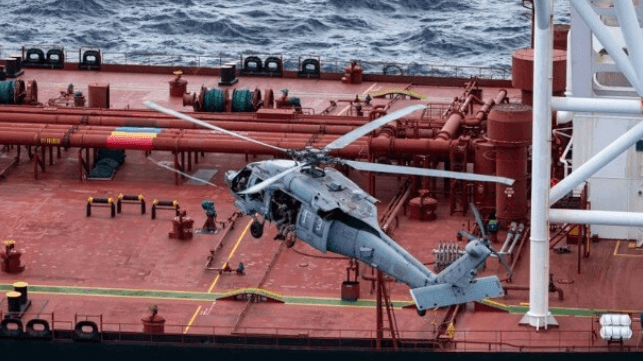
Such action would entail sealing the Straits of Hormuz to the passage of Iranian oil, by intercepting and taking control of tankers at sea. If one wanted to increase the pressure, one might also consider seizing Iranian oil held in floating storage off Malaysia and elsewhere, stocks of which Iran has built up as a reserve. Such an action might breach UNCLOS, but it would be no more egregious than the preemptive attack on Iran - or Iran's attacks on the GCC countries, which tried to remain neutral. This additional option would also have the benefit of bringing these reserves of floating stock to market, thereby reducing prices.
Interception of the ships would be relatively easy; the challenge would be in sailing seized vessels to protected anchorages and selling the oil into the global market, the proceeds of which the US Treasury could use to fund the US war effort. But with imagination and the right incentives, it would not be difficult to win over the cooperation of the crews of seized ships, only a small proportion of whom are actually Iranian.

that matters most
Get the latest maritime news delivered to your inbox daily.
The impact on the Iranian regime of a loss of revenues would be immediate if their oil sales were halted. The war effort needs money; it cannot be fought only with the capability in place before the war began, particularly as the war becomes one of endurance. But in particular, the regime needs money to fund and buy the loyalty of the IRGC internal security apparatus, and to provide subsidies and handouts of basic essentials - without which the anger of Iran's population would become unconstrained.
If the United States does not choose to block Iran’s oil sales, there is a risk that the nations most heavily impacted by the war - the GCC nations of the Gulf - will launch upon this action on their own. Given the relatively modest military capability needed to implement a blockade and seizure at sea program, the task is well within the means of the well-equipped GCC navies to manage on their own, with it pitched as being a compensatory activity rather than offensive direct military action against Iran.
The opinions expressed herein are the author's and not necessarily those of The Maritime Executive.